
Flagship investigation · Whales and land mammals
From land mammals to whales: how much of the transition can we reconstruct?
Fossils, genomes, anatomy and development preserve different parts of the history. Do they support the same ancestry? How well do they explain the transformation? And was the proposed pathway adequate within the available time?
This case assesses evidence against a proposed ancestry discontinuity under the Multiple Ancestral Lineages Hypothesis (MALH), a working alternative. It does not document a completed test of a fully specified independent-origin model. The current scientific assessment is stated openly.
Ancestry assessment available · major transformation and temporal adequacy assessments in progress
Jump to current assessment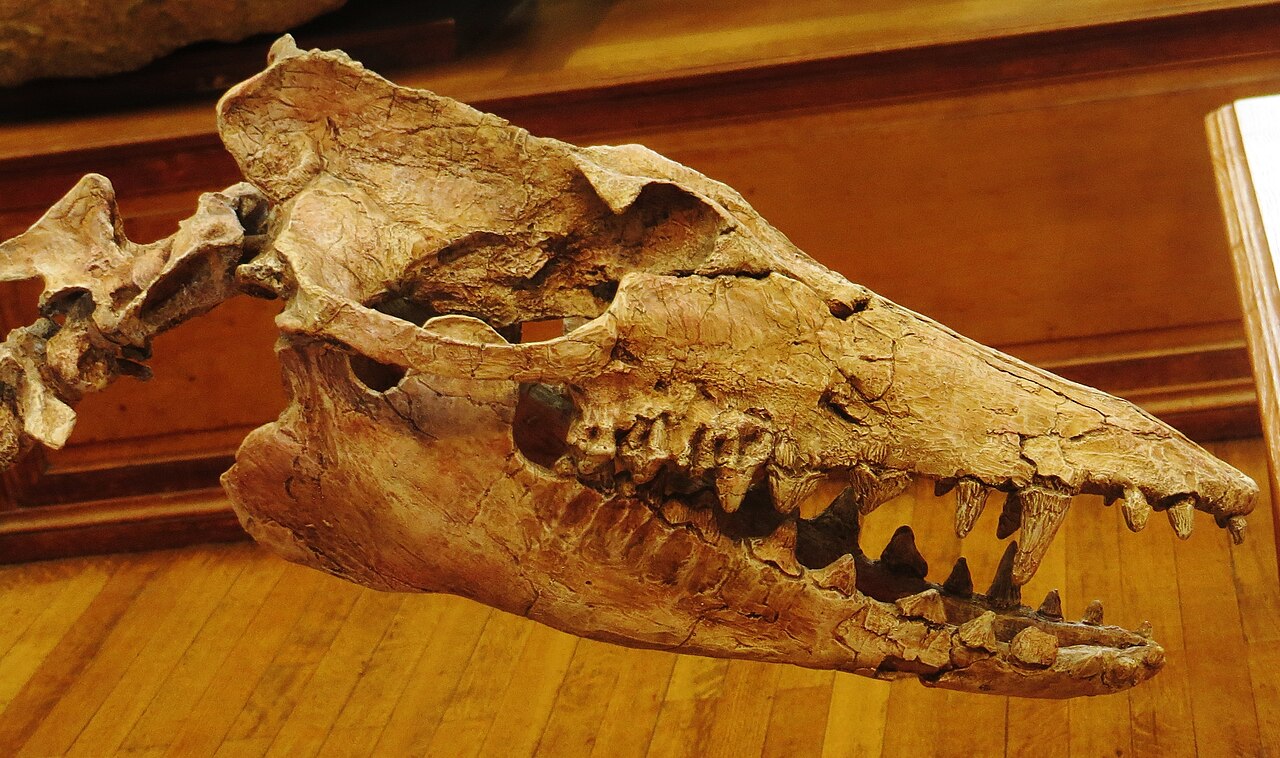 Actual specimen photograph
This museum photograph is an observation aid, not an ancestor claim or a conclusion by itself.
Image: Ghedo / Wikimedia Commons · CC BY-SA 4.0Understand · investigation rules
Separate the clue from the conclusion.
- 01
Begin with what researchers observed.
- 02
Compare interpretations and identify what an alternative still needs to specify.
- 03
Keep uncertainty and possible challenges visible.
Framework v2.1 case map
One case. Three conclusions kept apart.
How did the specified changes occur?
Assessment in progressCould the proposed pathway operate within the available time?
Assessment in progressExplore · Whale Evidence Lab
Audit the evidence behind the current assessment.
This case evaluates the proposed discontinuity between whales and land-mammal relatives. It does not reject every possible MALH boundary or decide whether all living cellular organisms share ancestry.
Prediction recorded: No · Stations reviewed: 0/3 · Full audit synthesis: Locked
Current assessment
Current ancestry assessment
Strong evidence supports shared ancestry between whales and land-mammal relatives at the tested boundary. The proposed MALH discontinuity at that boundary is not supported. This is a local ancestry assessment; it does not by itself establish or test universal common ancestry.
Evidence supporting this assessment: Fossils/anatomy (W-F01, W-F02) · Genetics (W-G01, W-G02, W-G03) · Development (W-D01). See each record’s role, use, and limits in Sources & Evidence.
Scope of this result
This case evaluates the proposed discontinuity between whales and land-mammal relatives. It does not reject every possible MALH boundary or decide whether all living cellular organisms share ancestry.
Major transformation
Assessment in progress. The complete pathway, mechanisms, intermediates, integration, and dependencies are not yet specified well enough for a final conclusion.
Temporal Adequacy
Assessment in progress. No temporal conclusion is authorized until the pathway and required parameters are adequately specified.
Understand · hypotheses and outcomes
How could an alternative ancestry hypothesis succeed?
A specified alternative must make positive predictions: observations expected under that model that distinguish it from shared ancestry. It must also identify observations that would count against it. The same proposed boundary must recur in appropriate evidence, survive relevant checks and fit better than the competing explanation. It cannot be moved after the result is known.
A proposed boundary loses support when its predicted break is absent or shared ancestry fits better. If evidence or model specification cannot discriminate, the comparison remains inconclusive.
Common ancestry remains the prevailing scientific interpretation. MALH is a working alternative, not an equally established theory.
Three possible outcomes. Unequal current support.
These scenarios explain the method. Only the first describes the direction of the current Whale evidence assessment.
Current Whale assessment
Illustrative hypothesis scenario

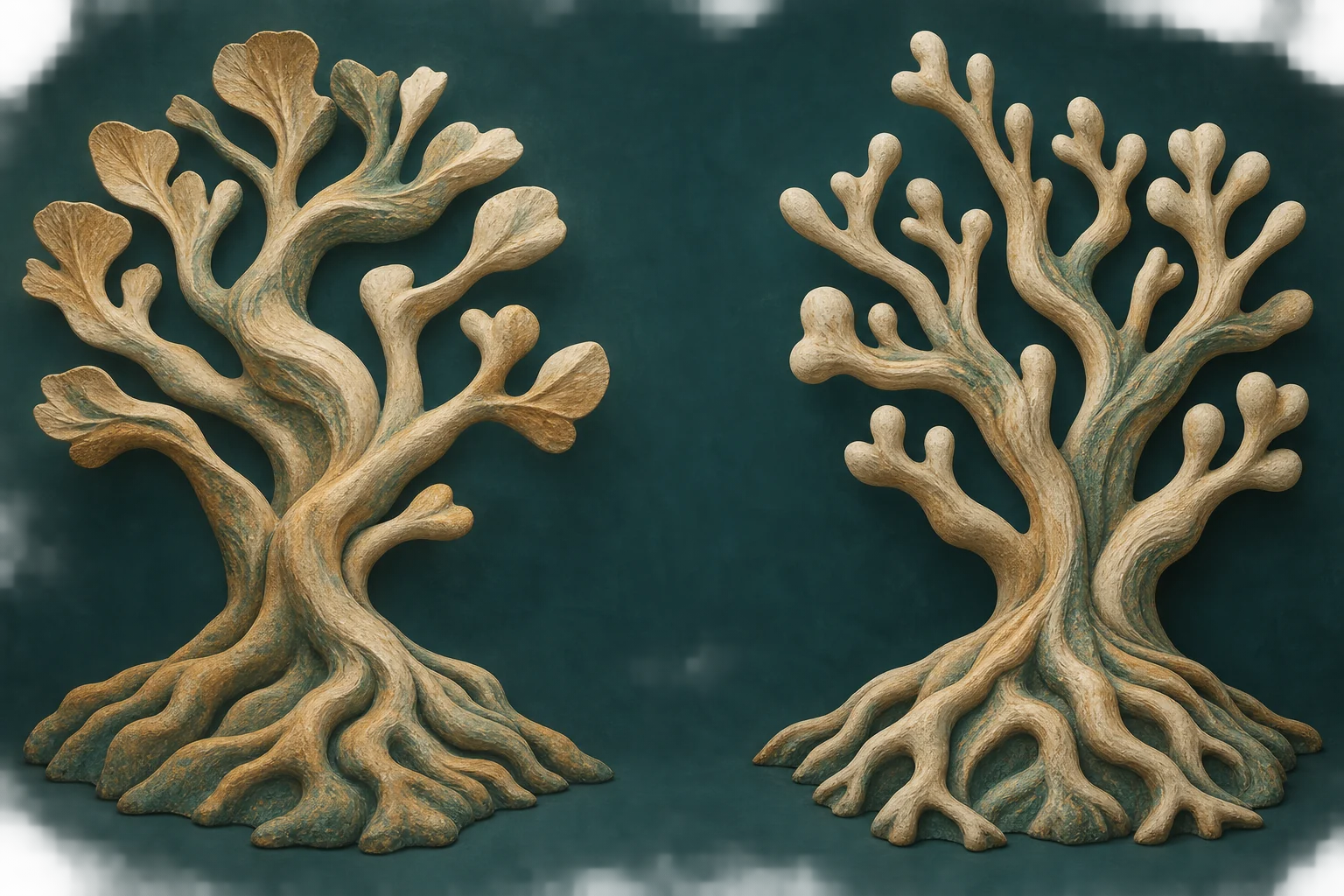
Shared ancestry
A connected family history
What supports this?
Compatible nested relationships, inherited patterns and fossil mosaics where preserved favor a connected genealogy after relevant checks.
This is the direction supported by the presented Whale evidence. The illustration itself supplies no evidence.
Possible assessment
Shared ancestry better supported
Hypothetical alternative · not found here
Illustrative hypothesis scenario
Separate ancestry
A stable boundary would need to hold up
What would support this?
The same defined break recurs across suitable, partly independent evidence. Expected cross-boundary continuity is not recovered after relevant checks, and a specified alternative predicts the pattern better.
A discontinuity alone is insufficient: independent corroboration, confounder checks and comparative fit are required.
Possible assessment
Alternative ancestry boundary better supported
Allowed outcome · no forced choice
Illustrative hypothesis scenario
Inconclusive evidence
Sometimes the evidence cannot decide
What would leave this unresolved?
Insufficient sampling, ambiguous patterns, model limitations or unresolved confounders prevent reliable discrimination between explanations.
This supports neither model. An incomplete alternative limits model comparison; it does not erase existing ancestry evidence.
Possible assessment
Evidence insufficient / comparison inconclusive
Compare the evidence streams and the alternative’s route to support
These are existing observations and framework-level conditions, not newly specified Whale-model predictions. Limitations do not automatically favor separate ancestry. No positive alternative-favoring observation is identified in the evidence presented.
Evidence lens
Fossils / anatomy
- Current support
- Temporally appropriate mosaics and a branching anatomical record support the local ancestry assessment.
- Limits / discrimination
- Preservation, dating, character coding and taxon sampling can affect individual placements. A gap is not an ancestry boundary.
- What could favor an alternative?
- A defined discontinuity that persists with improved sampling, recurs in other suitable evidence and fits a specified alternative better after confounder checks.
- Present in this case?
- No positive alternative-favoring observation is identified in the evidence presented.
Evidence lens
Genetics / genomics
- Current support
- Compatible nested insertions support the local relationship; broader genomic evidence supplies context within its stated scope.
- Limits / discrimination
- Marker selection, loss, homoplasy, lineage sorting and analytical error require checks. W-G02 is not a standalone boundary test; W-G03 is a marker limitation.
- What could favor an alternative?
- A stable boundary across suitable inherited datasets, with patterns better predicted by a specified independent-origin model after relevant confounders are tested.
- Present in this case?
- No positive alternative-favoring observation is identified in the evidence presented. Marker imperfection alone does not favor separate ancestry.
Evidence lens
Development
- Current support
- The retained-and-arrested limb program supports descent from limbed ancestors in the context of fossil and genetic evidence.
- Limits / discrimination
- It does not independently locate whales on the family tree. On its own, this observation does not discriminate the proposed ancestry boundary.
- What could favor an alternative?
- A tested alternative that predicts the developmental pattern without the ancestry under test could weaken that inference. Positive boundary support would still require distinguishing ancestry evidence.
- Present in this case?
- No such tested alternative is supplied. No positive alternative-favoring observation is identified in the evidence presented.
Open to revision
What could change this assessment?
- A robust recurring boundary and stronger predictive evidence for a specified competing ancestry model could shift support.
- Reanalysis showing important current signals to be artifacts or misinterpreted could weaken the ancestry inference.
- Evidence or model limitations that prevent reliable discrimination could make the comparison inconclusive.
A future test must fix its organism sets, datasets, predictions and decision rules before scoring. Keep earlier results visible; a changed boundary is a new proposal.
Method: Framework v2.1 boundary rules and decision states. Evidence and source limits: Evidence Ledger. This clarification does not change the governing framework or the current ancestry conclusion.
Summary
Are they related?
How did the change occur?
Two questions are being tested. First: are these organisms related? Second: how did the major changes occur? Evidence for shared ancestry can be strong even when parts of the transformation pathway remain incomplete. An incomplete pathway does not, by itself, show separate ancestry.
Technical detail
The local ancestry evidence assessment is available. A completed comparison with a fully specified independent-origin model is not documented. The major-transformation and Temporal Adequacy assessments remain in progress under Framework v2.1.
- 01Predict
- 02Fossils
- 03DNA
- 04Development
- 05Assessment
Do whales belong within the same branching family history as land mammals—or does the evidence reveal a genuine separate-ancestry boundary?
Step 2 · Prediction
Before opening the evidence stations, predict which interpretation the evidence will favor—or whether it may not discriminate. This learning exercise does not affect the current assessment.
What are cetartiodactyls and artiodactyls?
Cetaceans fall within Cetartiodactyla (or Artiodactyla in the inclusive usage of the cited study), and hippopotamuses are their closest living relatives in the cited retroposon analysis. Cetaceans are secondarily aquatic and are not hoofed in form. See W-G01.
Major Biological Transformation Assessment
What changed is clearer than the complete pathway.
The preserved evidence addresses parts of terrestrial-to-aquatic history, locomotion, hearing, limb modification, hind-limb reduction, fossil sequence, development, and genomic placement. Framework v2.1 requires a more complete specification before a transformation conclusion is made.
Specification required
The case must define the relevant terrestrial starting state and aquatic ending state at a defensible biological scale.
Assessment in progress
Existing observations must be mapped to proposed mechanisms, functional intermediates, integration, and dependencies without extrapolating beyond what the sources demonstrate.
Reliable records preserved
The existing fossil, genetic, anatomical, and developmental evidence remains in the case and Evidence Ledger. No new transformation conclusion has been inferred from it.
Temporal Adequacy Assessment
Assessment in progress
Temporal Adequacy evaluates the specified pathway against the best independently supported chronological interval relevant to the transition, including represented uncertainty. The current case has not yet specified every biological step, defensible rate range, population parameter, generation-time assumption, functional intermediate, alternative pathway, or sensitivity range. No temporal conclusion is made.
Having enough time would not demonstrate that the pathway occurred.An incomplete temporal model does not establish separate ancestry.
Read the Temporal Adequacy methodScientific Audit
Audit the case without mistaking a synthesis for raw data.
Each claim below is linked to a primary paper or scholarly synthesis. The project reports what that source supports and what it does not establish.
Open full scientific analysis
- W-F01Thewissen et al. (2007)Nature · DOI 10.1038/nature06343
- W-F02Bajpai, Thewissen & Sahni (2009)Journal of Biosciences · DOI 10.1007/s12038-009-0060-0
- W-G01Nikaido, Rooney & Okada (1999)PNAS · DOI 10.1073/pnas.96.18.10261
- W-G02McGowen et al. (2020)Systematic Biology · DOI 10.1093/sysbio/syz068
- W-G03Doronina, Ogoniak & Schmitz (2023)Genes · DOI 10.3390/genes14091830
- W-D01Thewissen et al. (2006)PNAS · DOI 10.1073/pnas.0602920103
What challenges this interpretation?
Fossil incompleteness, tree-model assumptions, marker selection, developmental sampling and partial dependence among evidence streams can affect strength. No single stream is decisive alone.
What could change the case conclusion?
A robust recurring boundary better predicted by a specified alternative after confounder checks could shift support. Demonstrated artifacts or misinterpretation could weaken current signals; insufficient discrimination could make the comparison inconclusive. These are revision conditions, not findings reported in this case.
Read the revision conditions and scope limits