Biological Origins Project · Framework v2.1
Does all life belong to one family tree?
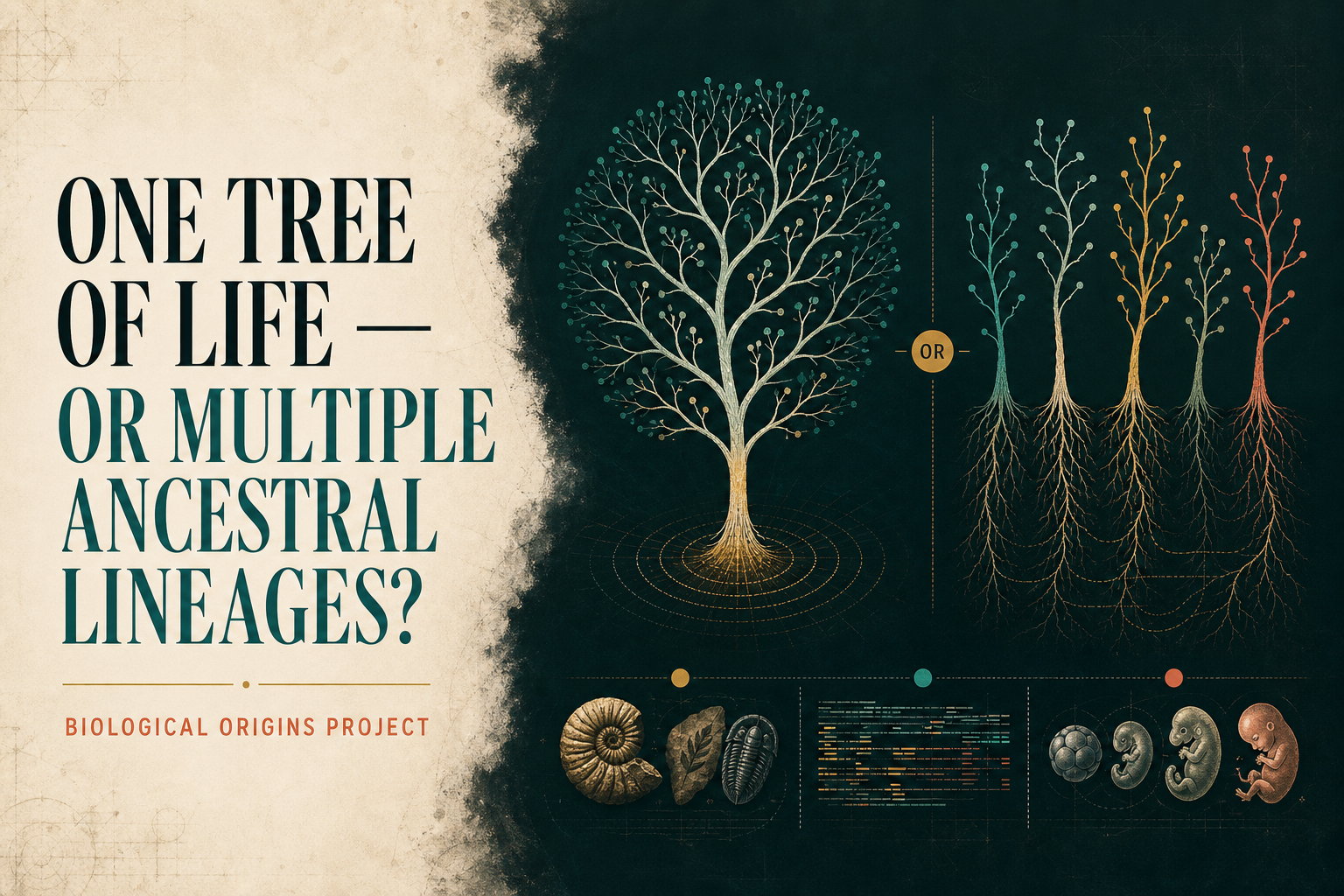
One tree of life—or multiple ancestral lineages?
Common ancestry is the prevailing scientific interpretation. MALH is a working alternative hypothesis, not an equally established theory.
AncestryMajor transformationBiblical interpretation
Evidence-to-inference mapObservation is not a tree.
A branching diagram is an interpretation derived from specified evidence under an analytical model.
- 01 · ObservationCharacters · sequences · fossilsMeasured or compared
- 02 · PatternCompatible groups within groupsStructure in the observations
- 03 · Phylogenetic inferenceBranching modelDerived under assumptions
- 04 · Model testCommon ancestryPrevailing scientific interpretationProposed lineage boundaryWorking alternative under test
Summary
How did the change occur?
Two questions are being tested. First: are these organisms related? Second: how did the major changes occur? Evidence for shared ancestry can be strong even when parts of the transformation pathway remain incomplete. An incomplete pathway does not, by itself, show separate ancestry.
Technical detail
Universal common ancestry (UCA) tests connected genealogy. The Multiple Ancestral Lineages Hypothesis (MALH) must pre-specify a candidate boundary, make distinguishing predictions, survive confounder tests, recur across suitable partly independent evidence, and outperform common ancestry under an explicit alternative model.
Explore · Test the boundary
If a real ancestry boundary exists, where should the evidence break?
Start with the prevailing connected model. Then test a proposed boundary: do independent lines of evidence repeatedly show the same discontinuity?
Interactive exhibit · conceptual modelPrevailing model: connected ancestry
shared rootAsampled lineageBsampled lineageCsampled lineageDsampled lineageEsampled lineage
Nested evidence is the default expectation.
Switch on a proposed MALH boundary to see the question the evidence must answer.
Explore · Phylogeny
What pattern should ancestry leave behind?
Start with the prevailing model. Then mark a proposed boundary and ask which observations could distinguish it.
Observed recordWhat can be measured or compared→Analytical inferenceWhat the model infers→Model testWhat could distinguish explanations
Observed similarity
Researchers begin with observed characters, sequences, insertions, fossils, anatomy, development, or distributions.
Stage cueCharacters · sequences · fossils
Boundary on interpretationSimilarity alone does not identify why the resemblance exists.
Inference model · derived from specified evidenceshared genealogy
A
B
C
Proposed boundaryPredict a repeated break across suitable evidence
Evidence lensPhylogeny
Compatible nested relationships across independently sampled characters.
Expectation: suitable inherited evidence should usually preserve compatible nested relationships.Scientific standing: common ancestry remains the prevailing interpretation. A proposed MALH boundary must make better, falsifiable predictions; a gap alone is not enough.
Read the complete observation-to-inference sequence
- Observed similarity. Researchers begin with observed characters, sequences, insertions, fossils, anatomy, development, or distributions. Similarity alone does not identify why the resemblance exists.
- Nested patterns. The question is whether suitable observations form compatible groups within groups across independently sampled characters. A nested pattern is an observation about structured correspondence; its historical meaning still requires inference.
- Phylogenetic inference. A tree or branching model is inferred from specified evidence under an analytical model. The diagram is not raw evidence and should not be treated as though the branching picture proves itself.
- Model assumptions. Character coding, taxon sampling, homology assessment, alignment, transfer, introgression, lineage sorting, convergence, paralogy, contamination, and model error can affect inference. Known complications must be tested rather than omitted from the display.
- Competing ancestry hypothesis. A Multiple Ancestral Lineages hypothesis must specify proposed lineages, stable boundaries, distinguishing predictions, and evidence that would count against it. A gap, unresolved mechanism, or taxonomic label does not by itself define an independent-origin model.
- Discriminating evidence. A proposed boundary becomes scientifically informative only if a pre-specified repeated break survives confounder tests and fits a credible alternative model better. Common ancestry remains the prevailing interpretation; the working alternative is not assigned equal evidentiary status.
Prevailing scientific interpretation
Universal common ancestry
Extant cellular organisms are connected through shared biological genealogy. Its scientific standing rests on converging evidence, not on definition alone.
- Prediction
- Suitable inherited evidence should usually preserve compatible nested relationships after known complications are modeled.
- Important distinction
- UCA is a proposition about connected genealogy. LUCA is an inferred ancestral organism or population within that history.
- Could be challenged by
- Before testing, the project would need to define exactly where a break is predicted. The same break would then need to appear repeatedly in suitable evidence and fit an independent-origin model better than common ancestry.
Technical criterion
A pre-specified, replicated boundary that fits a credible independent-origin model better across suitable evidence.
Alternative working hypothesis
Multiple ancestral lineages
MALH proposes at least two primary lineages without shared biological ancestry. It must be capable of failing and is not assigned equal evidentiary status.
- Must specify
- Lineages, stable boundaries, distinguishing predictions, and evidence that would count against the proposal.
- Cannot rely on
- A fossil gap, an unresolved mechanism, a taxonomic rank, or criticism of one common-ancestry analysis.
- Failed boundary on record
- The current whale-origin boundary is not supported. That result remains visible rather than being moved.
Question discipline
Ancestry asks whether organisms are related. Transformation asks how the biological change occurred.
Ancestry and mechanistic reconstruction are assessed independently.
Strong ancestry evidence does not automatically establish a complete mechanistic reconstruction. Incomplete mechanistic reconstruction does not automatically refute ancestry.
An incomplete pathway does not, by itself, show separate ancestry.
Analyze · Evidence domains
What would evidence against common ancestry actually look like?
No single gap or anomaly is enough. A scientific alternative needs a stable, pre-specified boundary that survives confounder tests and makes better predictions.
Phylogeny
Do independently sampled characters preserve compatible branching relationships?
Genomics
Do inherited sequences and rare genomic changes form stable nested patterns?
Fossils
Does improved sampling preserve continuity or a repeated, model-discriminating boundary?
Anatomy
Are proposed homologies better explained by inheritance, convergence, constraint, or another process?
Development
Do retained developmental programs add independent genealogical information?
Biogeography
Do distributions fit the proposed history after dispersal, extinction, and sampling are considered?
Chronology
Where ancestry-relevant, are proposed relationships compatible with independently supported ordering?
Confounders
Could gene exchange, mixed ancestry, similar features evolving separately, duplicated genes, contamination, or model error explain the pattern?
Technical terms
Gene exchange includes transfer. Mixed ancestry includes introgression and incomplete lineage sorting. Similar features evolving separately refers to convergence. Duplicated genes refers to paralogy. Model error includes model misspecification. Contamination remains a separate possible source of error.
Current ancestry assessments
Local results do not become global claims.
- Whale origins
- Strong evidence for shared ancestry at this boundaryThe tested MALH discontinuity is not supported.
- Global UCA
- Prevailing scientific interpretationThe whale case alone cannot establish UCA across all cellular life.
- Other MALH boundaries
- Insufficient evidence for assessmentNo completed public case review is available.
Summary
What to remember
- Ancestry asks whether organisms are related.
- Major transformation asks how the changes occurred.
- Strong ancestry evidence can coexist with an incomplete pathway.
- An incomplete pathway does not, by itself, show separate ancestry.